It’s a rainy Sunday in February. You’re staring at the living room. The sofa is comfortable. The coffee table is sturdy. But something feels off. It lacks that spark you see in glossy magazines.
You might think you need to open your wallet. Buy new couches. Replace the rug.
Wrong.
This is a classic budget killer, especially in the current economy. A dramatic transformation doesn’t come from buying more. It comes from mastering the details around what you already own. You can rediscover your home without replacing a single major piece of furniture.
Start with what’s free.
Clear the visual clutter first
We are deep in winter. You’ve been indoors for months. Your house has accumulated visual noise. The first step to renewal isn’t a purchase. It’s subtraction.
Decluttering is the most cost-effective renovation strategy.
Start by stripping the surfaces. Remove anything that isn’t strictly useful or deeply decorative. Those mismatched remote controls? Gone. The stack of unread mail? Trash. The odd knick-knacks that no longer bring you joy? Gone.
Modern decoration is often about less, but better.
Once the tables are clear, play strategist. We have a habit of pushing furniture against walls to “save space.” This freezes the energy of the room. It makes the space feel rigid.
Try shifting your sofa just a few inches. Change the orientation of your bed. Move a dresser from the bedroom to the hallway. Sometimes, simply removing a tablecloth to reveal the raw wood underneath is enough to modernize the entire look.
Organize your remaining objects using the odd-number rule favored by interior stylists. Don’t line up vases like soldiers. Group them in threes or fives. This creates a dynamic visual imbalance that feels intentional. It looks curated. It costs nothing.
Use textiles and light to change the mood
This is where the real magic happens. If furniture is the skeleton, textiles are the skin. They are the soul of the room.
In February, you need warmth. But you also crave clarity. The trick is swapping out soft accessories. Changing two or three cushion covers can instantly elevate a basic sofa.
Focus on natural textures. This is slow decoration in action. Mix materials that feel good to the touch:
- Washed linen for a timeless, slightly crumpled chic vibe;
- Bouclé wool or thick cotton for relief and comfort;
- Corduroy velvet for a retro, warm touch.
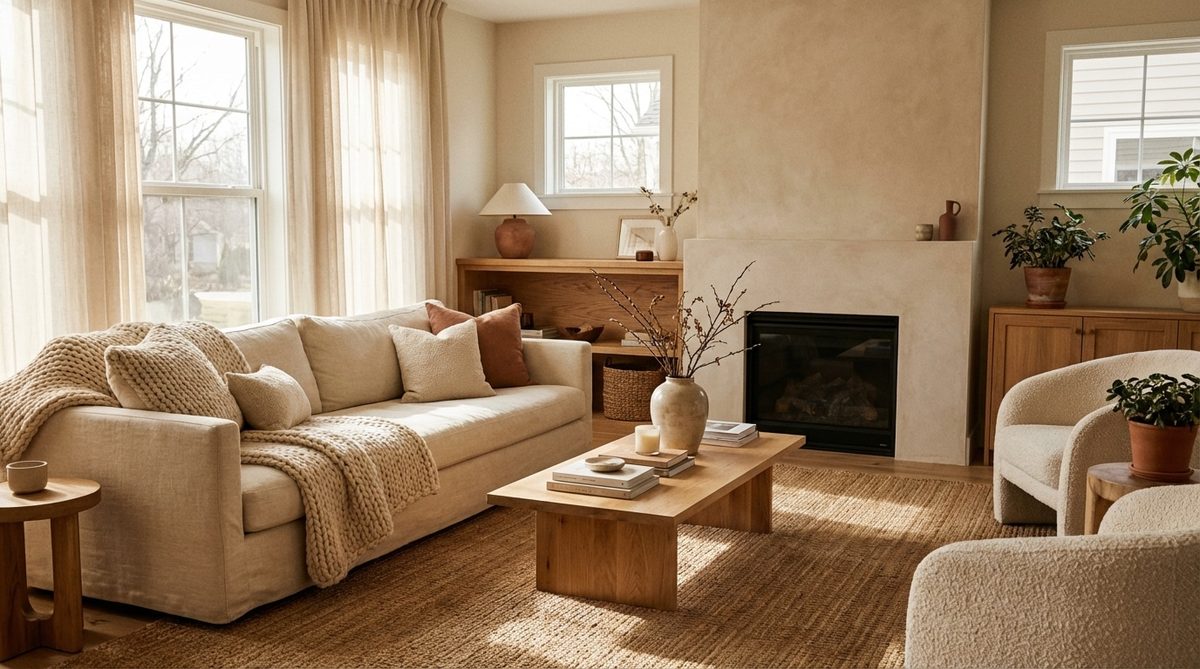
Watch your color palette. You don’t need to repaint the walls to update your space. Stick to earth and nature tones. Warm beige and ecru work as safe, luminous bases. Wake them up with accents of terracotta, deep brown, or soothing sage green.
Pick one dominant color. One neutral. One accent color. This prevents the rainbow effect that fatigues the eye.
But none of this matters if your lighting is wrong. This is the most neglected aspect of many interiors.
Ditch the cold white light. It gives your home an institutional, hospital feel. Check your bulbs. Switch to warm white (2700K).
Multiply your light sources. A single ceiling fixture crushes the volume of a room. Add a table lamp. Place a floor lamp near the armchair. Hang a subtle string of lights in a bookshelf. Use shades made of paper or rattan to filter the glow. Even a bland room gains instant elegance with the right shadow and light.
The structure is set. The clutter is gone. Now you have texture. You have warmth.
Does your room feel different yet? Or are you waiting for the perfect painting to hang above the mantel?
Hardware swaps and lighting that actually work
You don’t need to gut the house to make it feel new. Often, the difference between a dated interior and a curated one comes down to the small stuff. Take that inherited dresser. It’s solid wood. It has history. It’s just stuck in the 90s.
Fix it with hardware.
Swap out those worn wooden knobs for brass, matte black, or even leather pulls. It’s reversible. It costs next to nothing. The result is a radical style shift that makes the furniture look intentional rather than leftover.
Sourcing pieces without feeding the landfill
Don’t buy new decor if you can find it with a pulse. The secondhand market is where the real personality lives.
Check platforms like Leboncoin, Vinted Home, or local Emmaus stores. You will find treasures that have character. A vintage frame bought for pennies, cleaned up or repainted, beats a sterile mass-produced reproduction every time.
Lighting and textiles do the heavy lifting here.
- Mirrors: Hang a large mirror with organic shapes. It expands the visual space and bounces your new lighting around.
- Biophilia: Add life. A healthy green plant or dried branches in a handmade ceramic vase grounds the room. It connects you to the outdoors without the maintenance of a garden.
Creating depth with paint (without the mess)
Painting an entire room is labor-intensive. Paint a single wall or a geometric shape behind a sofa instead.
Choose a strong, grounding tone. Olive green. Deep beige. This creates a visual alcove. It adds depth and focus without the commitment of a full repaint. It’s a low-risk way to inject color.
The intention behind the upgrade
Transforming your home isn’t about how much money you spend. It’s about how consciously you choose.
Reorganize what you already have. Clean the windows. Upgrade the lightbulbs. Pick textiles that feel good. You breathe new life into your space. You respect your budget. You respect the planet.
Start with one small change. One handle. One plant. One wall. See how it shifts your daily routine.