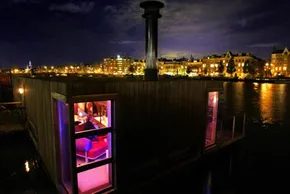
It’s what it sounds like. A house that floats.
Some people call it a barge with a roof. Others see a million-dollar mansion on the water. The definition is loose, but the reality is physical. You can buy one brand new from a manufacturer. You can snag a used one from someone tired of the damp. Or, if you’re ambitious, you can build your own entirely from scratch.
But before you start welding steel or buying lumber, you need to know what you’re actually buying. Most people get tripped up by the terminology. It’s nautical language. It’s the same stuff used for yachts and submarines. If you haven’t spent time onboard, the specs look like gibberish.
The biggest split isn’t about size or price. It’s about movement.
Non-Cruising Houseboats Explained
This is the most common kind of floating home. Think of it as a stationary structure with plumbing.
These boats aren’t meant for the sea. They have limited mobility, or none at all. You might see a small engine or a tiny sail on some models, but it’s rare. Most of the time, they are moored, anchored, or tied to a slip in a marina.
You park them. You live in them. That’s it.
If you want a low-stress lifestyle where your “home” doesn’t change address every weekend, this is your category. They are simpler. Cheaper to maintain. And they don’t require you to be a seasoned captain.
Cruising Houseboats: Built for Motion
Cruising houseboats, often called “bluewater” models, are built for excursions.
This isn’t a dock dweller. This is a vessel. These boats have engines. They have sails. They rely on fuel for mobility.
The engineering is different. The hull is reinforced. The systems are more complex. You’re not just living on water; you’re navigating it.
If you buy a cruising houseboat, you’re signing up for a different set of skills. You need to understand navigation. You need to handle fuel consumption. You need to know how to tie up in unfamiliar harbors.
Decoding the Lingo
Why does this matter? Because the paperwork will use specific terms.
If you’re looking at specs, don’t guess. Look up the nautical lingo. Terms like “draft,” “beam,” and “displacement” aren’t just decoration. They dictate where you can go. They dictate how deep the water needs to be. They dictate how much wind your boat can handle.
You wouldn’t buy a car without knowing what the gears do. Don’t buy a floating home without knowing what the hull does.
The line between a raft and a yacht is thin. But the line between a parked boat and a moving one is thick. Pick your lane. Then learn the vocabulary. The water doesn’t care about your confusion.
Understanding Houseboat Terminology
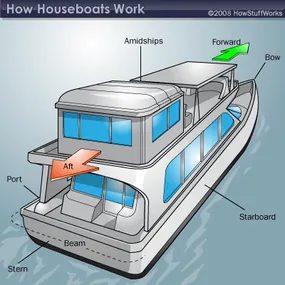
You need to know the layout before you try to live in it. Most terms are borrowed directly from sailing vessels. The front is the bow. It usually ends in a V-shape to cut through water. The back is the stern.
Directional terms matter when you are moving around. Moving toward the front is forward. Moving toward the rear is aft. If you stand facing the bow, your left side is port. Your right side is starboard. The middle section is called amidships.
Key Measurements for Docking and Living
Two measurements define the physical footprint. Length overall (LOA) includes the entire hull. It stretches from the tip of the bow to the very back of the stern. Marina managers use this number. It tells them exactly how much slip space your houseboat will occupy.
The interior length is different. This is the hull length. It measures the space where you can physically walk. This number predicts your actual living area. It helps you gauge square footage before you sign a lease.
Draft and Beam
The beam is the widest part of the boat. It determines width stability.
Draft measures how deep the boat sits in the water. This is a critical safety factor. You need to know the draft to avoid scraping the bottom. Rocks and shallow spots can damage the hull. A shallow draft allows access to tighter channels. A deep draft offers more stability but limits where you can anchor.
Knowing these terms helps you navigate marina rules. It also helps you understand the constraints of your new home on the water.