The first warm months of the year naturally invite you to refresh your outdoor spaces. Renovating a wooden pergola, reviving faded shutters, or protecting a newly installed fence top the aesthetic priority list for the season. You meticulously prepare your materials. You clean the surfaces with rigour. You imagine already admiring a brilliant final result. In this frenzy of DIY, the idea of using ambient heat to speed up the process seems brilliant. Put down the brush. Let the burning rays do the work. It theoretically saves precious time before the weekend.
But this rush against the climate hides a formidable trap for outdoor projects. Very quickly, instead of enhancing the elegant grain of the material, thick powdery stains appear. They instantly ruin the visual aspect of the work. Understanding the mechanical origin of these unsightly defects is indispensable. You need this knowledge to avoid sacrificing your budget and the many hours of effort invested in the project.
The dangerous mirage of express drying
Summer heat offers the seductive illusion of formidable efficiency on wood treatment sites. Solvents seem to evaporate before your eyes. This gives the impression that a second coat can be applied immediately. However, this artificial acceleration is the worst possible technical error.
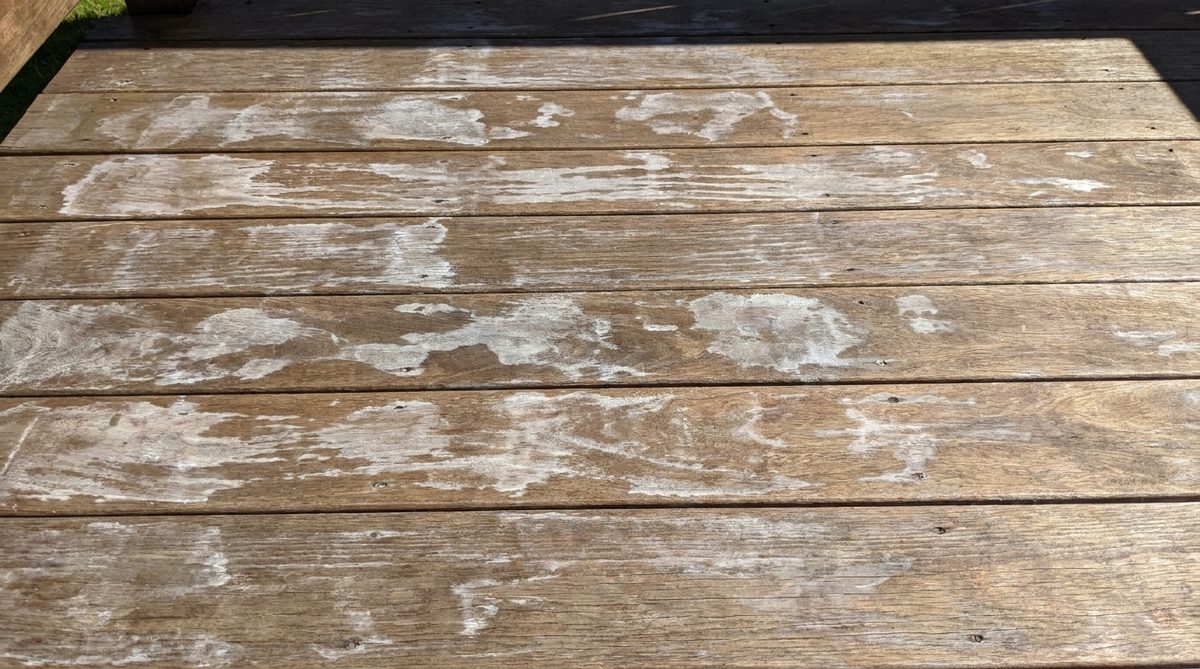
Under the June sun, exterior wood stain dries too fast. It leaves indelible white streaks across the entire support. The desire to finish quickly turns mercilessly against the person holding the brush. In just a few minutes, a protective finish supposed to be totally transparent becomes covered in ugly, opaque, and rough patches. This aesthetic disaster annihilates all preliminary steps. The painful stripping. The meticulous dusting. The financial investment in high-quality resin pots becomes useless when the natural clock is rushed in this manner.
Intense ultraviolet rays, combined with extreme temperatures, literally cook the component. It happens before the product can properly adhere to the fibrous substrate of the wood.
Why heat creates a milky haze
To grasp the origin of this spectacular reaction, you must look at the application dynamics of these specific coatings. A high-performance protection must penetrate organic pores slowly. It needs to nourish them deeply while allowing volatile compounds to escape progressively.
When the heat is oppressive, an upper film hardens instantly upon contact with the burning air. This sudden thermal shock freezes the external part. It traps the fresh liquids underneath. It also traps residual moisture from the fibres. The direct result is micro-condensation beneath this newly formed lid. It is precisely the rapid accumulation of these trapped micro-droplets that creates that famous milky haze everyone fears.
The chemical mixture never had the capacity to spread or polymerize homogeneously. This ravaging phenomenon, often called efflorescence, destroys not only the aesthetic interest of the operation. It also cancels out all hydrophobic properties supposed to block out the elements.
How to salvage your woodwork and the weather lesson
When facing this type of decorative disaster, hoping to repair the coating by simple washing or spot polishing is totally in vain. The integrity of the layer is structurally compromised. Drastic measures are imposed to regain a truly healthy support. Here are the only viable actions to right the situation with success:
- Use an eccentric sander on the entire damaged area with a medium grit abrasive. Aim for an 80-grit sandpaper to remove the compromised surface.
- Finish with a fine 120-grit paper to achieve perfect smoothing. Remove every single trace of opacity without exception.
- Dust meticulously with a soft brush, then follow with a slightly damp cloth.
- Wait imperatively for external temperatures to drop below the critical threshold of twenty-five degrees Celsius before opening a new pot.
The golden rule for any outdoor work during the hot period is clear. You must work exclusively in the cool shade. Prioritize the early morning hours or the calming twilight. These narrow time slots ensure the maintenance of an adequate temperature. It stays ideal between twelve and twenty-five degrees Celsius. This allows varnishes and other protections to act without precipitation or wild evaporation.
By trying to bypass the natural rhythm of materials with the burning rays of fine days, the opposite effect occurs inexorably. The maintenance burden doubles. So does the financial investment needed to erase the damage caused. Respecting the physical reactions of protections against the outdoor environment remains the only secret to a durable embellishment. One capable of crossing the years without any bad surprises.
Urgency is fundamentally a bad ally when it comes to maintaining your open-air habitat. Humble observation of the weather and patience remain undoubtedly the best tools for any perfectly accomplished project. So, for the next major renovation of the gate or the terrace, why not take advantage of the morning calm to apply each brushstroke under excellent climatic conditions? The sun doesn’t wait for you. Why should you rush it?