You plug it in. You close the window. You get cold air. It feels like magic, but it is just basic thermodynamics packed into a box. A window air conditioner is a self-contained system. It fits into a standard frame. That is its main selling point. Simplicity.
Take the cover off an unplugged unit. You will see the guts. There is a compressor. There is an expansion valve. You have a hot coil on the outside and a chilled coil on the inside. Two fans sit in there too. They blow air over the coils. This moves heat outside and pushes cold air into your room. It is a closed loop.
Why Choose a Window AC Unit?
If you are renting or have a single room to cool, this is usually the way to go. It is cheap. It is installed by one person. You do not need a contractor. You just need a sturdy window sill and a power outlet nearby.
But what happens when you want to cool more than one room? Or when the noise from the fan bothers you? That is when you look at split-system air conditioner units.
The name gives it away. The system is split. One part stays inside. The other part stays outside.
How Split-System AC Units Work
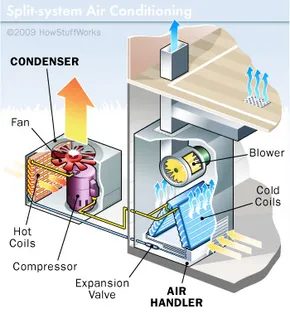
Inside your house, you have an air handler. This is often hidden in a closet or attached to your furnace. It holds the cold side of the system. The expansion valve and the cold coil live here. A fan blows air through this coil. Ducts then carry that cool air to your rooms.
Outside, you have the condensing unit. It sits on a pad or hangs on a wall. This is the loud part. It contains a long, spiral coil shaped like a cylinder. Inside, there is a fan and a weather-resistant compressor.
Why go through the trouble of splitting them? Two reasons. Cost and comfort. The indoor space is quiet. You do not hear the compressor humming. The trade-off is noise outside. Neighbors will hear the outdoor unit. But most homeowners accept that trade-off.
When to Upgrade to Split Systems
Window units have limits. They are small. You cannot cool a whole house with them. Split systems handle higher capacity. The coils and compressors are larger. They can move more air.
In a typical home, the split-system approach works well. The distance between the indoor and outdoor units is manageable. The ductwork is straightforward. You are not stretching the system too thin.
But what if you have a two-story house with thick walls? Or a large open-plan living area? The split system starts to show its cracks.
The Problem with Long Runs
If you try to push a split system too far, you run into physics. The pipe connecting the condenser to the air handler has length limits. If that run is too long, the refrigerant flow slows down. The compressor loses lubrication. It can seize up. You are looking at a very expensive repair.
Ductwork is another issue. Long duct runs lose energy. Insulation degrades. The air gets warm before it reaches the bedroom. If your ducts are too long or too complex, the system becomes inefficient. You are wasting electricity.
Knowing When to Stop DIY
For window units, you are safe. You can install one yourself this weekend. For small split-system air conditioner applications, a skilled DIYer might manage the mounting and basic wiring. But the refrigerant lines require certification in most places. You cannot just solder copper pipe in your backyard.
If you are dealing with a warehouse, a large office, or a multi-story home, stop. The window unit is too small. The standard split system is too inefficient over long distances.
At that point, you are no longer looking at AC units. You are looking at a chilled-water system. That is a different world. But that is a problem for another day. For now, clean your window unit filter. Check the seal. Make sure the sash is tight. It sounds trivial. But a bad seal lets warm air in and cold air out. You will pay for that leak in your


