A house fire starts in France every two minutes. Not every day. Every two minutes.
It is a relentless pace. And while we worry about stoves or irons, firefighters keep pointing to a quieter culprit. It sits in the laundry room, humming away while you are out shopping. The dryer.
One professional firefighter put it bluntly to the Journal du Net. It is not the oven. It is not the iron. It is the machine that spins quietly in the background.
The Silent Champion of House Fires
No official statistic nails this down precisely, but the Fondation des Brûlés ranks the dryer at the top of electrical appliances likely to cause fires. It surprises people. We associate dryers with clean clothes and fresh scents. Not flames.
Some sources put it in second place for dangerous electrical devices. But the numbers circulating in specialized press are starker. This type of appliance is behind 22% of domestic fires in France. One-fifth of all home blazes.
To put that in perspective: that is as many as all kitchen accidents combined in some studies.
The danger comes from a specific chemical-like logic. Intense heat meets high humidity. Textile fibers and dust accumulate. If the airflow is blocked, the heat rises. It hits the ignition point.
Short circuits or control system defects also play a role. But the plastic components inside? The accumulated lint? They can burst into flame all at once.
The Clogged Filter: The Primary Suspect
The risk stems from the buildup of heat and dust inside the drum. The Fondation des Brûlés notes that hot air mixed with dust creates an “ideal” mix for ignition.
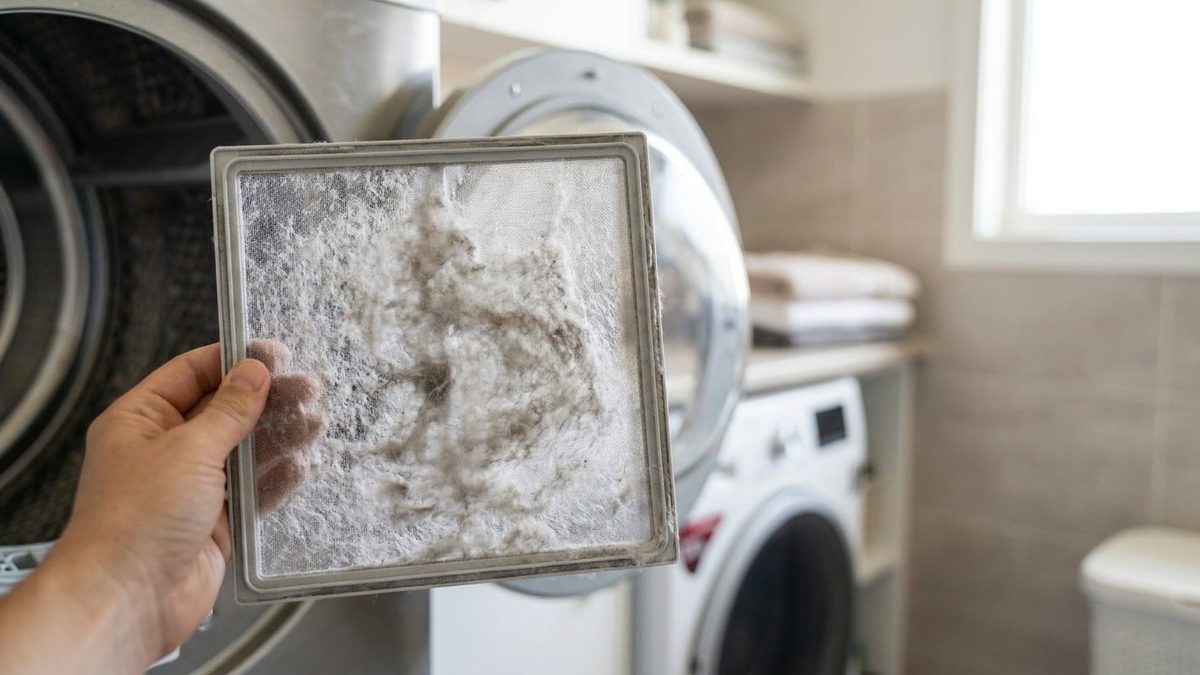
The lint filter is the first link in that chain. Most users clean it… sometimes. Not often enough.
A firefighter cited by Neozone illustrated this sharply. When the dryer runs, it produces textile residue. Some call them “bobbinettes” or lint balls. The firefighter uses them as kindling. They ignite very quickly.
Every cycle creates a small pile of perfectly combustible amadou. It sits at the heart of an appliance heating to dozens of degrees.
Other causes exist. Defective electrical connections. Blocked ventilation grilles. But the lint accumulation is key. A poorly maintained filter counts. So does a bend in the exhaust duct.
These bends often get stuck between the wall and the appliance. They create dead zones. Lint piles up there. Heat stagnates.
Many fires happen only after years of use. The new dryer rarely burns the house down. It is the five-year-old or ten-year-old unit. The one whose duct was never inspected.
Never Leave It Running Alone
French firefighters are firm on this rule. Electrical appliances that produce heat—dryers, dishwashers, washing machines—must not be programmed or used when no one is home.
This guideline is in SDIS prevention guides. Yet the general public ignores it. Everyone knows not to leave a pot on the stove unsupervised. Nobody thinks about their dryer.
The first advice is clear. Never run the dryer without occupants in the apartment. The device should remain under supervision from the moment it starts until the cycle ends.
What about night? Same logic. Running the machine while sleeping carries a comparable risk.
These fires spread fast. They can jump to other parts of the house quickly. The laundry room is usually near a hallway. Often on the ground floor in detached homes. Exactly where fire blocks exits most effectively.
On the night of February 5-6, 2023, eight people died in Charly-sur-Marne. A mother and her seven children. The prosecutor said a dryer on the ground floor of the house started the blaze.
It is a simple machine. But it demands respect. Clean the filter every time. Check the ducts. Stay in the house. The difference between a warm towel and a tragedy is often just thirty seconds of maintenance.
Or staying awake.
The heat keeps rising. The lint keeps building. The question is whether you are watching.
The 30-Second Ritual That Saves Homes
Forget the yearly check. You need to clean the lint screen after every single cycle. Thirty seconds. That is the single most cost-effective fire prevention move you can make. Most people treat dryer vents like an out-of-sight, out-of-mind chore. They wait until they remember. Don’t be that person.
Experts are clear on this. Clean the trap every time. Then, get professionals to blow out the ductwork regularly. Not annually. Not bi-annually. Keep it clear. Lint is fuel. It is highly flammable cellulose. It sits in your ducts, waiting for a spark or enough heat to ignite.
Clearing the Airflow and Debris
Your dryer needs to breathe. Leave space around the unit. Don’t push it flush against the wall or cram it into a tight closet without proper ventilation. Blocked airflow causes overheating. Overheating causes fires.
Vacuum around the base of the machine too. Lint falls. It gets everywhere.
There are hard limits on what goes into the drum. Never dry clothes that have touched flammable substances. Oil. Paint. Solvents. Those vapors concentrate in the dryer heat and can explode.
Mushrooming isn’t just a garden problem. Items made of foam or rubber are also high-risk materials. They degrade under high heat and can contribute to rapid fire spread. Stick to standard fabrics. If you are unsure about a stain, air dry it first.
The Silent Watchdog You Can’t Ignore
What if the dryer is running while you are asleep or at work? You cannot watch it. You cannot hear a crackle over the hum of the motor.
This is where a smoke detector changes the math. Since March 9, 2015, a standalone smoke alarm (DAAF) is mandatory in every French residence. But having one in the hallway is not enough.
Place at least one detector every 50 square meters. Place one right outside the laundry area. The location matters. A detector in the hall might not wake you fast enough if the fire starts in the adjacent room. A detector near the dryer gives you seconds.
Seconds. That is the difference between grabbing your keys and escaping.
The Speed of Destruction
Fire does not care about your schedule. A room temperature of 600°C can be reached in just three minutes.
Three minutes.
That is not a lot of time. It is barely enough time to walk upstairs, find your keys, and put them in your pocket. By the time you realize something is wrong, the heat may already be lethal. The smoke will be thick. The exit may be blocked.
Install the alarm. Clean the lint. Leave the space open. It is simple. But simplicity doesn’t save you. Action does.
Sources : pompieractu.fr | fr.news.yahoo.com


