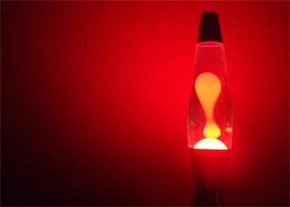
They first appeared in dormitories and bedrooms in the 1960s. They are now an integral part of pop culture. From the US to Europe, people still buy them. Designs have evolved. Manufacturers offer hundreds of variations of the original concept. However, the core mechanism remains the same.
We analyze these fascinating devices. You will see the blobs moving. You will learn more about history. And you get a head start on building your own. The next time you see one, you don’t just look. You will understand.
Ingredients of Movement
A motion lamp is surprisingly simple. It is based on basic physics. It consists of three main parts.
First, a substance for floating “blobs”.
Second, the liquid in which the blob floats.
Third, the lamp. It provides light and warmth.
The two liquids must be immiscible. This means they don’t mix. Liquid A refuses to dissolve in liquid B. They stay separate. One could sit above the other. Or one could suspend within the other.
Think oil and water. Add mineral oil to a glass of water. You get two different layers. Oil floats because it is less dense. Turn off the motion lamp light and you’ll see something similar. Two separate layers. No movement.
Why density matters
The magic happens when the blobs rise and fall. This requires a careful selection of materials.
The water sinks into the oil and water jar. It is denser than oil. A high-density liquid pushes a low-density liquid upwards. This is the same principle that makes helium balloons rise.
To create dancing blobs, you need two substances with almost identical density. You must be close. This allows the blobs to easily switch between ascending and descending. You also need a way to change the density. Sometimes one has to be lighter than the other. Then heavier. This change guides the movement.
Heating a Motion Lamp
Heat is the engine. It changes the density. It creates a cycle. Next, let’s see how this works.

How temperature regulates density and movement
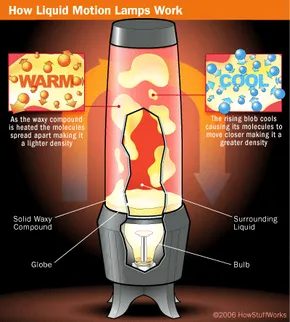
Temperature is the primary lever for changing the density of most compounds. Heat agitates molecules, pushing them further apart and reducing the density. When you cool them, the molecules gather closer together, increasing their density. Water expands significantly when heated, which you may recognize from the way traditional thermometers work.
Inside the motion lamp, this physical principle creates an continuous loop. When the lamp is turned off, a solid waxy mixture settles to the bottom of the ball. This solid is only slightly denser than the surrounding liquid.
Turn on the bottom light and the cycle begins:
- Heat melts a solid into a liquid. The phase change causes expansion, causing its density to drop below the density of the surrounding fluid.
- This warmer, lighter blob rises to the top of the globe.
- Away from the heat source at the bottom, the blob cools down a bit. It becomes denser than the surrounding liquid, but not cold enough to solidify again.
- The lump sinks back to the bottom, where it warms up and rises again.
The concept is simple. Balancing it is not.
The challenge is the exact relationship between the compound’s properties, the intensity of the heat and the dimensions of the globe. Commercial manufacturers tightly guard specific ingredient formulas and technical tolerances. It has proven nearly impossible for hobbyists to replicate the smooth, continuous motion of store-bought models.
The history of the motion lamp

The history of motion lamp
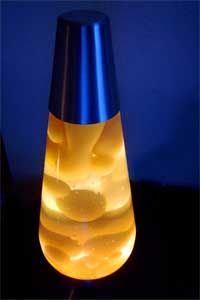
Edward Craven Walker is credited with inventing the motion lamp, but the story is complicated. He developed core design in the 1950s in England with egg timers. Or maybe he saw a simpler version at a bar. Either way, Walker made the concept a cultural icon. He died in 2000 at the age of 82.
He spent nearly a decade refining the Astro Light. His company Cresworth launched it in 1963. Sales are okay. Then things exploded.
In 1965, two Chicago entrepreneurs, Adolf Wertheimer and Hy Spector, saw Astro Light at a trade show in Germany. They bought the US patent rights. They formed Lava Manufacturing Corp. They created their own version. Lamps became a staple of the counterculture.
The company is now Lava World International. They still make almost all Lava Lite commercial products sold in the US. They are fiercely protective of their Lava Lite ® trademark. People call it a “lava lamp”. It is genericized. Just like Kleenex. But the law disagrees. The word “lava” by Lava World in print.
After being heavily promoted in the US, Astro Light continues to be popular in Europe. Sales declined in the 1980s. Walker sold the rights to Cressida Granger. Her company, Mathmos, still manufactures lamps for markets outside the United States. They have added modern variations. Both Mathmos and Lava World ride the wave of nostalgia that started in the 1990s. Sales are going well.
Build your own motion lamp
This site offers plans for a DIY liquid motion lamps. You won’t find the exact recipe. This is top secret. To making the blobs, you must solve chemical puzzles. It requires two compounds that float and sink without mixing.
An easy way to do this is to uses mineral oil with mineral oil. The surrounding liquid is 70% and 90% rubbing alcohol. The alcohol content must be balanced. Match the density of the oil.
Color the blobs with an insoluble dye. You can use Permanent marker ink. Use tall glass containers. Safety matters. Do not use bulb of more than 40 watts. Heat can break the seal or cause the mixture to boil.
Other designs use complex ingredients. These chemicals are typically more expensive than store-bought lamp. This is a good experiment. Learn how density works.
Warning: This can be dangerous. Mix chemicals and apply heat. If you don’t know what you’re doing, don’t try. Wear safety glasses. Use an apron. Check our disclaimer online. Most websites will display a warning.
Related Topics
- 荧光棒的工作原理
- 灯泡的工作原理
- 黑光灯的工作原理
- 伽利略温度计如何工作?
- 船如何漂浮在水中?
- 鱼如何在水中升起和下沉?
- 波浪池的工作原理
- 潜艇如何工作
- 氦气球的工作原理
- 热气球的工作原理
- 专利如何运作
- 什么是商业秘密,它与版权有何不同?
- 什么是蛋黄酱以及它是如何制作的?
链接
- Mathmos
- 熔岩灯辛迪加
- 液体运动灯计划
- 制作你自己的熔岩灯